
Money, Money, Money
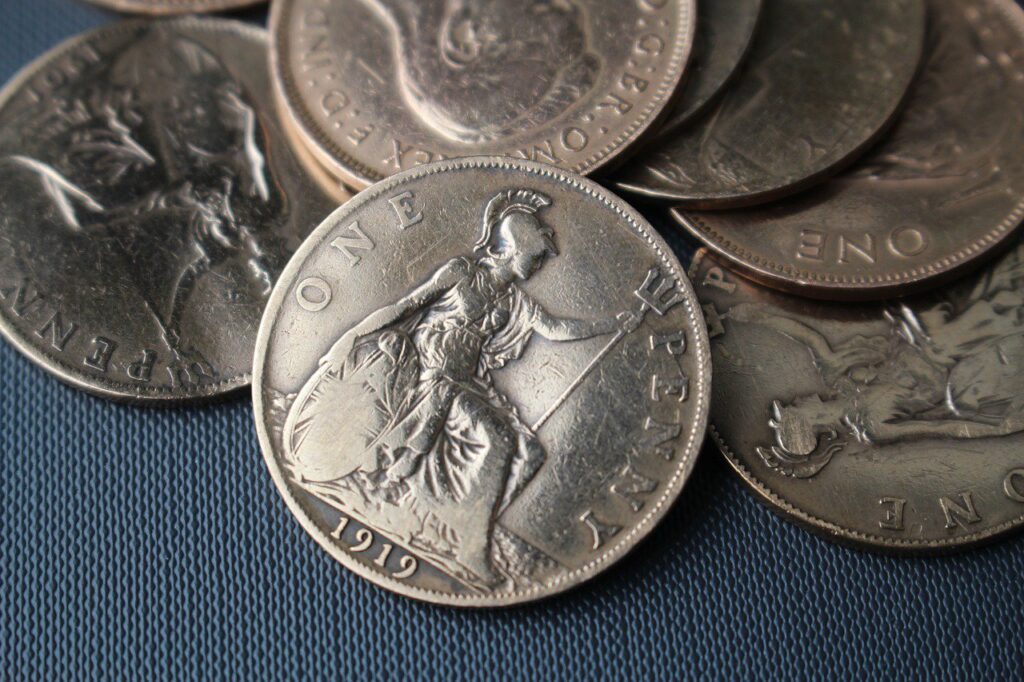
“In for a penny, in for a pound.” “Take care of the pennies, and the pounds will take care of themselves.” “A penny for your thoughts.”
British English has plenty of sayings and proverbs relating to the country’s currency. But how many pennies (or is it “pence”?) are there in a pound? And what about other monetary terms like shillings and farthings? British currency, both historic and modern, can be quite a mystery if you’re not familiar with it. In this post, we’re going to take a whistlestop tour and hopefully shed some light on the subject.
But before we get to the likes of how much a shilling was worth, an important thing to know is that the British monetary system changed in 1971. Well, it didn’t completely change; it was simplified by the process known as decimalization. Prior to that, as we’ll see shortly, British currency was quite complex. Decimalization saw the pound retain its value, but instead of having a hotchpotch of seemingly random subdivisions, it was now to be made up of 100 pence, just as other national currencies, such as the US dollar, are divided into 100 smaller units.
In truth, the process had been gradually advancing over the previous five years when the new system was first announced, with some coins being withdrawn and others being introduced. “D Day” was 15 February 1971, though, when the change was completed. (You can find out more about the timeline and process from this article on the Royal Mint Museum website.)
In a similar way to when you visit another country and convert the currency to price things in your own, Britons did the same until they got the hang of the new system. As you might imagine, it took quite a while for the country to adjust. Even now, you’ll hear elderly people occasionally joke “what’s that in old money?”, an idiom which dates from this time. Now, though, when they say this, they’re not actually referring to money, of course, as we’ve had enough years for everyone to get their heads around that. Instead, this delightful phrase continues to be used simply about anything that might have changed.
And now returning to pennies, what about the word “pence”? Although in colloquial speech you may hear people say things like “Have you got a one-pence coin?”, “pence” is actually the plural of “penny” – but only when referring to an amount of money. “Pennies” is the plural when referring to a number of coins. So, something might cost fifty pence, but you’d need fifty pennies to pay for it.
Having cleared that one up, let’s dive into the mysterious world of predecimal currency. While pennies and pounds were around before 1971, there were also a number of other subdivisions of the monetary system, a system that had evolved over hundreds of years.
The main larger unit, the pound, was so called as it was originally worth one pound in weight of silver (thanks, OED) and is a monetary unit that has been around for well over a thousand years. The pound was divided into shillings, which in turn were divided into pence. Before the Norman Conquest of 1066, there was no standardisation as to how many pence to a shilling, and it varied depending on which part of the country you lived in. Once the Normans took control, though, they decreed there were to be twenty shillings to the pound, with each shilling made up of twelve pence. Doing the sums, then, there were 240 pence to a pound. As someone who grew up in the post-decimalization era, I can understand why the government decided that the currency needed modernising.
Although pounds, shillings, and pence were the main basic units of predecimal currency, there were other coins and values to add to the mix. The smallest of these was the farthing, which might be familiar to non-Brits from the name of the old-fashioned bicycle, the penny farthing. A farthing was a small coin and was worth a quarter of a penny. (And, as an aside, it lent its name to the bicycle as the two wheels of said machine contrasted in size, just like a penny, which was a very large coin predecimalization, and a farthing.)
Between the farthing and the shilling and the shilling and the pound, there were a number of other coins and denominations, some of which are self-explanatory, like the halfpenny (pronounced “HAYP-nee”), threepence, known as the threepenny (typically pronounced “THREP-uh-nee” or “THRUP-uh-nee”) bit, and the sixpence (pronounced “SICK-spuhnts”). Others need a bit more explanation though.
The florin was worth two shillings, and, along with the shilling coin, the florin was kept in circulation after decimalization. Post-D Day, the shilling was used as a five-pence coin and the florin – two shillings – became a ten-pence coin. I remember these coins from my childhood, but they were gradually replaced, of course, by new designs.
Next in ascending value came the half crown, worth two shillings and sixpence, and the crown, five shillings. The half sovereign, worth ten shillings, followed these, and then came the full sovereign, a coin worth a pound. Is your head spinning yet? As we said earlier, it’s no wonder the government decided it was time to reform the currency.
And finally, on our tour of the British monetary system and coinage, we come to the guinea. The guinea was a gold coin originally worth one pound, although that wasn’t fixed as the value of gold fluctuated, of course. However, the guinea was eventually set at twenty-one shillings, i.e. one pound and one shilling, but was only legal tender until 1816. After that, it did continue be used as a unit for accounting, though, and today still remains a familiar term in horse racing. For example, the 1000 Guineas and the 2000 Guineas are two classic English horse races which take place every year at Newmarket racecourse. And it’s not just races that use the term: racehorses themselves are often also valued in guineas rather than pounds. You can find out more about the guinea in the world of horseracing here (although please be aware that this links to a gambling website).
And with that, we come to the end of our whistlestop tour of British currency and coinage. I hope you can now easily tell your farthings from your florins and your shillings from your sixpences. Maybe the penny has now dropped with you about this fascinating finance system.