
A British Christmas Dinner
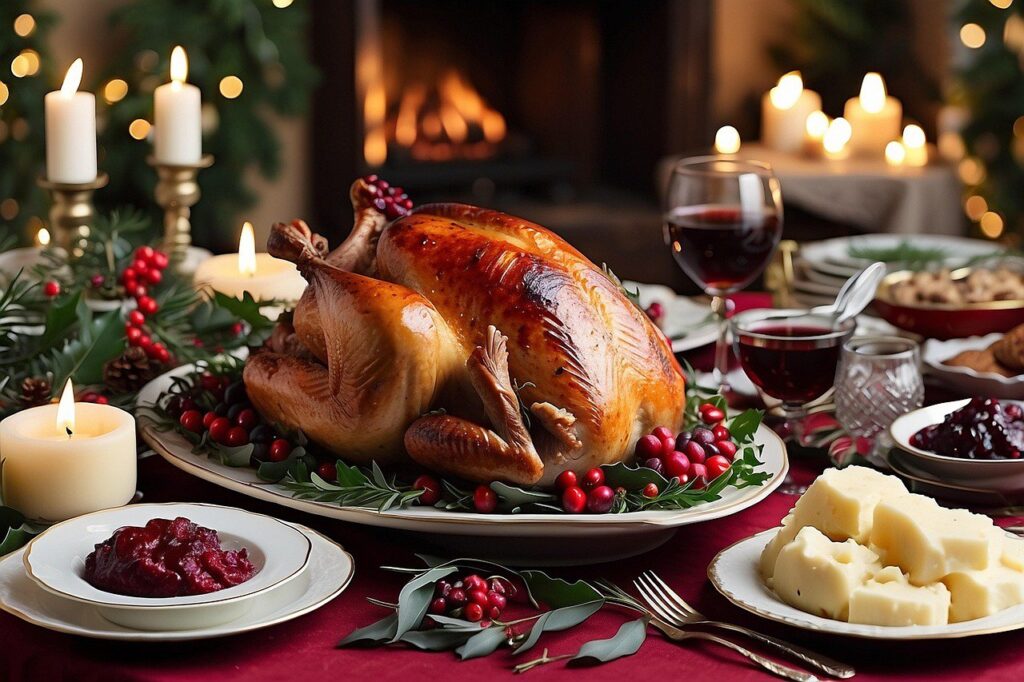
“Christmas is coming, the goose is getting fat. Please do put a penny in the old man’s hat.”
We’re in December now, and Christmas really is coming, although the rain currently pouring down outside isn’t making me feel very Christmassy! But let’s not worry about that and turn our thoughts instead to food and what will be on British dinner tables when the big day arrives. We’ve already mentioned the goose and I’m feeling hungry, so let’s get started.
Turkey
If you asked most British people what a traditional Christmas dinner looks like, they’d probably describe a plate of delicious turkey, roast potatoes, and vegetables, with lashings of gravy. Pigs in blankets (small sausages wrapped in bacon) would also feature on many people’s menus, as well as stuffing and cranberry sauce.
What no goose? Well, no, at least not these days, although in Victorian times when our rhyme was popular, goose would have been the meat of choice unless you were very wealthy. The rich could afford beef, venison, or turkey. This is perfectly illustrated in Dickens’ A Christmas Carol: the Crachit family’s Christmas table held a small goose, but Scrooge bought them the butcher’s prize turkey at the end of the book.
The decline in popularity of the goose happened during the early-mid twentieth century, with the well-off preferring turkey while the working-class opted for chicken for their special meal. The latter was actually quite an expensive meat at the time, and my mother-in-law tells me that Christmas was the only occasion on which her family ever ate it. Turkey, however, continued to be beyond the means of many people. According to a BBC article, a turkey cost about a week’s wages in the 1930s, so although it was becoming more popular, many people didn’t have the money to spend on such a thing. It wasn’t until the 1970s that it finally started to become affordable for most people and cemented its place as the traditional Christmas dinner meat. It remains the most popular choice today.
Christmas Pudding
You’ve stuffed yourself with that delicious turkey and all the trimmings, then, so what next – if you have room? Quite possibly Christmas pudding, which is still the most popular dessert for the big day.
Before we get into the details about that, though, just a note on the word “pudding” for my North American friends, as this word means different things depending on which side of the pond you’re from. In the UK, “pudding” is often a word used to describe the dessert course of a meal. This meaning comes from the days when this course would have consisted of a “pudding”, which, according to the OED’s thorough explanation, is a “boiled, steamed, or baked dish made with various sweet or (sometimes) savoury ingredients, added to a mixture typically including milk, eggs, and flour (or other fatty or starchy ingredients such as suet, rice, semolina, etc.), or enclosed within a crust made from such a mixture.” That was a bit wordy, but hopefully it gives you an idea of what a “pudding” originally was, which is relevant to our discussion about Christmas pudding. These days the word is often used for any dessert, not only the type just described. “We had ice cream for pudding”, for example, is perfectly normal UK English.
In North America, though, I realize that “pudding” refers to a particular type of dessert, usually of a soft or creamy consistency, so quite different from what was described in the previous paragraph. As a Brit, I’m glad that I’m aware of this as it helps me to make sense of the phrase “her knees turned to pudding”!
After that small digression, let’s get back to our Christmas pudding. This dessert is a boiled pudding made of dried fruit, nuts, eggs, sugar, breadcrumbs, spices, and suet, generously laced with alcohol. The recipe evolved from a more savoury dish over the centuries, and it was the Victorians who popularized it in its current form. (Think A Christmas Carol again.)
The pudding is traditionally made on “Stir-up Sunday”, which is the fifth Sunday before Christmas. As the name suggests, each member of the family takes their turn in stirring the mixture before it’s put into a pudding basin and steamed for several hours. The pudding is then stored in a cool, dry place until Christmas day, when it’s steamed again for a while longer before serving. The preparation and cooking is a time-consuming process, and these days, many people prefer shop-bought puddings that can be heated in a few minutes in the microwave.
The epitome of tradition is to serve Christmas pudding by bringing it flaming to the table. Brandy is heated in a pan and lit before being poured carefully over the whole pudding. If you have the technique right, you should be able to carry your spectacular-looking pudding to your guests, flames dancing around it.
Once the pudding is served, diners traditionally eat it with brandy butter or custard, which is a sweet yellow sauce made with milk or cream. Custard is also the traditional accompaniment to any hot dessert in the UK.
Before we leave our Christmas pudding, though, another tradition to mention is the cooking of various trinkets into it, which supposedly predict what is to come to those who find them. The most well known of these is the silver sixpence, a predecimal coin. Whoever finds one in their portion can anticipate wealth in the year ahead. This tradition is dying out now, though, due to hygiene reasons. You won’t find a coin or any other charms or trinkets in your shop-bought pudding, although some home bakers do continue the tradition.
So that, my friends, is a little glimpse of a traditional British Christmas dinner, main course and pudding. Some people may precede these with a starter, and others may choose to follow them with a cheeseboard. And there might even be a glass of sherry before dinner – how civilized! Doubtless the meal will be followed by tea and coffee and perhaps after-dinner chocolates, quite possibly of the mint variety.
In our next blog post, we’ll carry on with the food theme and look at British Christmas baking. Merry Christmas, one and all!
Thanks to the following interesting and useful articles for additional information: The YouGov Christmas dinner survey, The British Hamper Company’s Christmas blog, and English Heritage’s articles on Christmas dinners through the ages and the history of the Christmas pudding.