
Pregnant
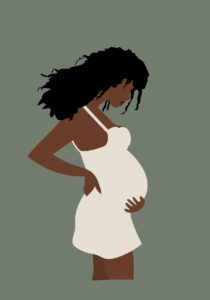
Are there any new babies due in your family in the near future? Or maybe among friends and neighbours? We became great aunt and uncle for the second time a little earlier this year and are looking forward to meeting the new addition very soon.
Even though there are no more new babies on the way for our family at the moment, I always seem to know someone who’s pregnant. It’s a common and natural part of life, of course. However, what about the words used to describe the state? I’ve wanted to write a blog on this topic for a while, so here goes.
In days gone by, using the word “pregnant” to describe a woman expecting a baby would have been regarded vulgar, and any number of euphemisms and alternative expressions would have taken its place. “Pregnant” was reserved for the medical arena and wouldn’t have been used in respectable conversation to refer to human females.
The term is originally Latin, and its use was recorded in English by the fifteenth century according to the OED. However, although it initially seems to have been an acceptable word to use relating to a woman, with John Milton using it in Paradise Lost (1667), it fell out of favour, seemingly sometime in the 1700s.Throughout the nineteenth and first half of the twentieth centuries, many alternative terms were used, including “in an interesting condition”, “in the family way”, and “carrying”.
If you search the internet, you’ll find reference to the US TV show I Love Lucy, which, in 1952, famously aired an episode entitled Lucy is Enceinte, the French word for “pregnant”, which was also used in English as a “politer” term. The word “pregnant” was deemed to be too crude to appear in the show’s title.
It is widely reported that the late Queen Elizabeth II, who was born in 1926, didn’t use the word as she found it vulgar and preferred “in the family way”. Also, I can’t remember my own mum, who was born in 1939, talking about anyone being “pregnant”; she would say that the person was “expecting a baby”.
It wasn’t until the 1950s and 60s that euphemisms for being pregnant began to be replaced by the word “pregnant” itself, as plain speaking about matters such as sex and reproduction became more common. Google Books Ngrams, an online resource which gives the frequency of a word appearing in print, shows a small, steady increase in the use of the word “pregnant” between the 1920s and 50s and then a very sharp rise from the 1960s.
If you’re writing a historical novel set before the 1960s, then, you would be advised to avoid using the word “pregnant” and choose one of the many alternative terms that were employed before that time. If your book is set after 1960, you might also want to think about your older characters who would have had their formative years prior to the 1960s. Would they be like the late Queen or my mum and prefer a gentler term to “pregnant”?
For two informative and varied articles about alternative terms for pregnant, see The Victorian Web and Merriam-Webster Dictionary.